Sign in. It’s quick, free and it’s up to you.
An account is an optional way to support the work we do. Find out more.
Sign in. It’s quick, free and it’s up to you.
An account is an optional way to support the work we do. Find out more.
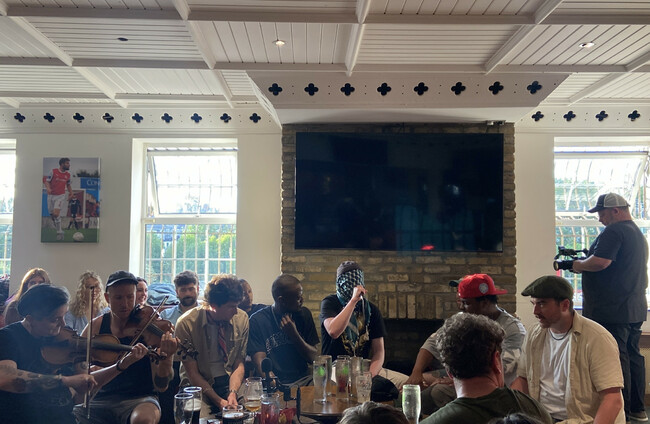

In this brand-new series, journalist and spoken word artist Cormac Fitzgerald travels to a different town or suburb each week to cover the gigs and cultural experiences you rarely see covered by Irish media outlets.
This week’s subject: Trad music meets hip hop on a Saturday afternoon in Inchicore
*****
O’NEILL’S MARCH (also known as Marcshlua Uí Neill) is a very well-known piece of traditional Irish music. Even if you think you don’t know the tune, you probably do.
Believed to have been a clan march dating back to the 17th century, it was re-popularised by the Cork composer and musician Seán Ó Riada for his legendary 1959 Ó Riada Sa Gaiety concerts.
With its resonant flute, uileann pipes and whistles, deep open bodhrán and steady marching rhythm, O’Neill’s is a powerful and affecting piece of music. You could ride into battle to it.
The Celtic Rock band the Horslips took the tune as the central guitar riff for their popular 1973 track, Dearg Doom.
That same riff would later be heard in the 1990 smash hit and official Italia ’90 World Cup song for the Republic of Ireland soccer team, Put ‘Em Under Pressure (yes, that one).
It has gone on, in the way of these things, to be adapted and remixed by many musicians since.
It is fitting, then, that the tune is the first one the players strike up in the back room of McDowell’s in Inchicore, Dublin 8, after the rappers have joined the circle.
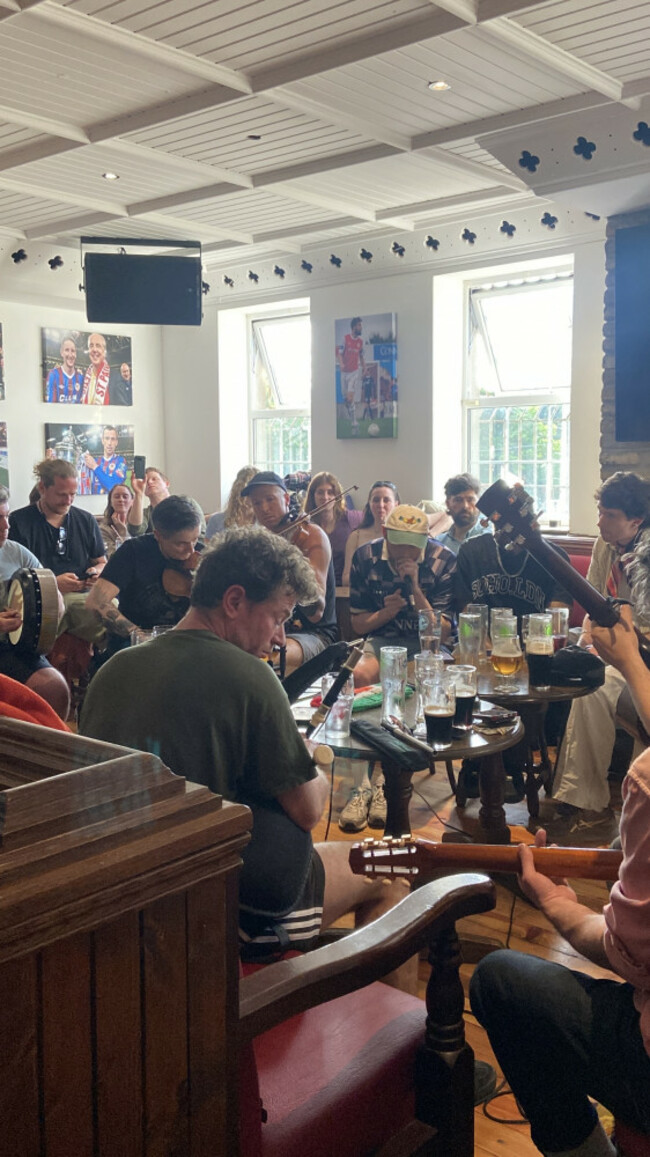
Up until now, the sunny Saturday afternoon session has been proceeding as normal: a group of musicians sitting around playing jigs, reels, polkas; there is a flute, a whistle, a fiddle, a concertina, a bodhrán and a pair of guitars, with everything being led by the accomplished uileann piper and sean nós singer Iarla Ó Muirthile.
The tables are loaded with pints of Guinness and beer, glasses of water, minerals and cordial, tobacco pouches and packets of crisps.
But this is no ordinary session.
Surrounding the musicians, on the outside of the circle, about 40 of us have gathered inside on one of the hottest days of the year to see what will happen.
The name of the event is Comhcheol, an Irish word meaning harmony (literally “mutual-” or “co-music”). After the musicians play for about 40 minutes, Blue Niall, the rapper and multidisciplinary artist who has brought this all together, invites the rappers to take up some empty chairs.
“We’re after widening the circle and bringing some musicians of a different kind into the traditional session,” Blue Niall says into a microphone, wearing a hat with a blue and white scarf wrapped around his face and head.
“And we’re about to try and fuse two things together. We’re going to kick it off with Marcshlua Uí Neill which is a traditional march… we’re going to take that as a start point and have a few different MCs on this.”
The pipes start up, the musicians get going again, and the comhcheol properly kicks off.
It has become almost banal to say that Irish popular culture is thriving.
Everywhere you look, there’s another article being written about how the Irish film industry is booming, how our actors are winning Oscars, our writers are winning the Booker Prize, our musicians are storming the charts and taking home huge awards on the international stage, our language is growing, our samba dancers are second to none (okay, I made that last one up).
This boom in all things Irish also extends to two separate but sometimes interrelated strands of music: traditional / folk and hip hop.
Along with big names in rock and pop like Fontaines DC and CMAT, there has been a massive surge in popularity for traditional folk acts. Groups and musicians like Ye Vagabonds, John Francis Flynn, Lisa O’Neill, the Mary Wallopers and many more have brought trad and folk to a new generation.
As well as this, there is an ever-growing number of musicians fusing traditional music with more modern sounds like hip hop and electro to create something new.
Leaning in to the spirit of adaptation, rearranging and reinvention that is, strangely, at the heart of much traditional music, you also have groups and solo artists like Lankum, RÓIS and others who add specific elements and instruments to old music to create new soundscapes and styles (“doom folk”, in Lankum’s case) and make it their own, while others, like the rapper Strange Boy, fuse trad with hip hop and other musical styles.
Blue Niall is firmly situated in this fusion of styles, language and music. An Irish speaker who grew up listening to hip hop and trad, he samples trad tracks for his music (like the ubiquitous O’Neill’s March for his track, Aisling), layering them with electric elements and heavy bass and adding his own vocals on top to create something frantic and heavy. Niall also makes use of different media to tell stories that reach back into Ireland’s mythical past in order to address issues in its present.
His latest project, OISÍN, is a modern retelling of the Legend of Tír na nÓg, which imagines Oisín Mac Cumhaill as a young man forced to emigrate from Ireland to Tír na nÓg (London, or anywhere) and that explores contemporary Ireland’s past, present and future. The project makes use of a mixture of music, video, images, memes, costume and installation.
It is consciously nostalgic and fiercely political, using familiar icons and images from the 90s and 2000s to interrogate the ghosts of Ireland’s past and present, as well as explore the Ireland of today, and why young people are forced to emigrate in such large numbers. It does this while also facing forward to imagine the future of the island.
It is this sense of outrage and political action and community that inspired Niall to start the Comhcheol project last year. The aim is to work with asylum seekers who have come to Ireland to create music and bridge cultural and social divides. And this is what we are all doing here in McDowells, waiting to see the musicians bring rap and trad together to see what comes of it.
“I feel what Irish hip could benefit a lot from is just more communal vibes, more freestyling culture, more cypher culture,” says Niall.
“Because hip hop is relatively new in this country, we don’t have that deep culture of people who grew up rapping around the lunch table in school, for example.
But what we do have is the traditional session culture as well… and I think the fusion of the two things is very interesting.
The rappers joining the circle as O’Neill’s March strikes up include Irish people and asylum seekers. The Comhcehol project involves people from countries like Lesotho, South Africa, Zimbabwe, Indonesia, Palestine. Blue Niall sees the coming together as a way to get people off social media and their phones and into an actual physical space where differences can be aired and worked out.
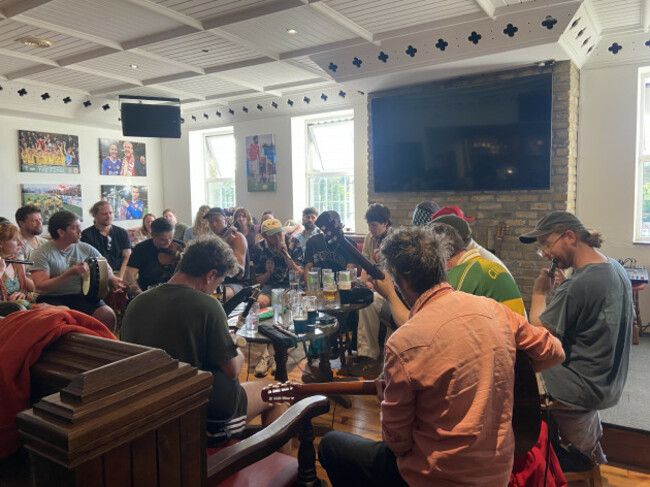
“We’re looking at new people coming to the country, and people are questioning: are they welcome? What is Irish culture? All of these questions are really live and I was wondering can we get in a room together.
“Rather than being online talking shite about each other or at each other, what happens when you get people around the table?”
Let’s find out.
After a few bars of O’Neill’s March the rappers start to join in.
First up is Curtis, a Dublin rapper, who gives his 16 bars (the classic length of time for a freestyle or a verse in a rap song) before passing the mic to Blue Niall who sounds off some bars from his songs on the OISÍN project. As the tune progresses, others jump on the mic, freestyling or rapping prepared verses, performing in English and Irish.
All the while, the musicians keep the song going, going round and round with march, the tune rising and falling, swelling and dropping and gathering in energy as the rappers and the crowd do.
Things start off slow enough, but pretty quickly the group gels and finds their flow, the crowd gets more into it, the musicians get the groove and the time passes by in a flash.
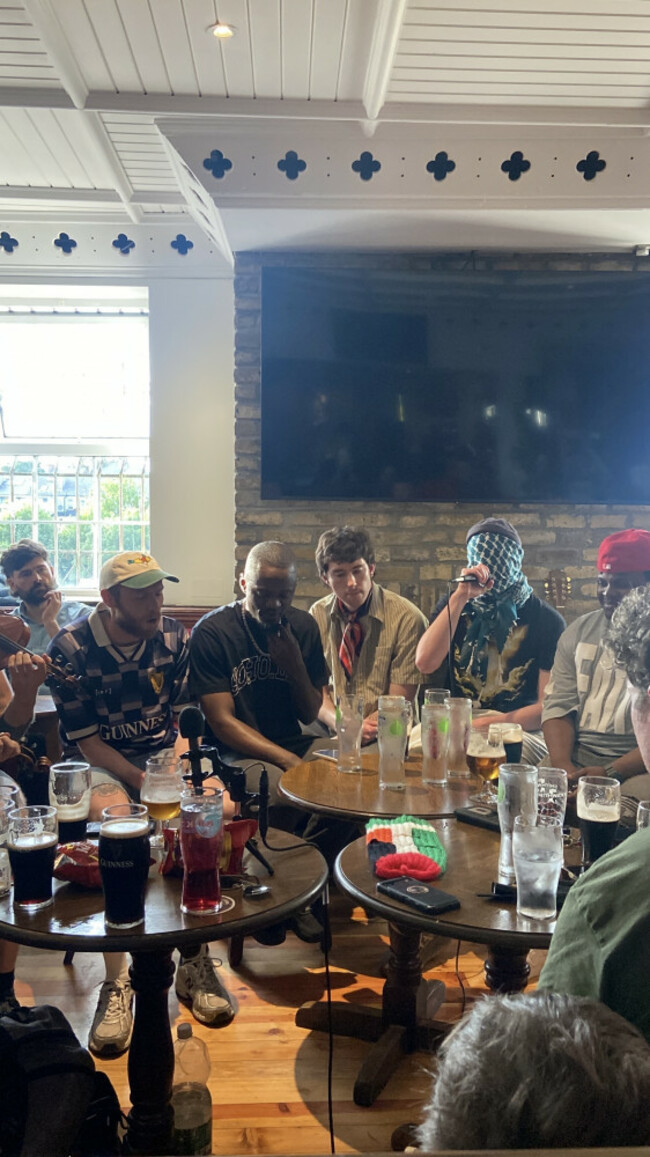
Once O’Neill’s ends, there is a slow air for people to speak poetry over, and a set of slip jigs that continue the music.
Overall, there is great energy in the room from the music and the rapping. At times, I lose myself in the rhythm, not fully the words but getting caught up in the beats and the sounds.
I think it is a success. Afterwards, the crowd are buzzing, the musicians start to pack up and people venture outside to the smoking area to catch the last of the sun.
“I enjoyed it so much. But I told Niall I was so afraid before I got on,” JiJiF, one of the rappers, tells me afterwards.
“We did these rehearsals and I was thinking, ‘Man this is something so new’, I’ve never jumped on this, so I don’t know how it’s going to go. Is it going to fit with the culture?
Bro, but this is just musicians sharing music so whatever piece you got, that’s you. So, yeah. It turned out better than I thought. I was nervous as hell. I feel great now. It felt so good doing it over the pipes.
On the other side of the music, Iarla Ó Muirthile, the piper, says he was also surprised at how well it went.
“I’m a lot more open now to doing more after doing it, to be honest. At the start… I thought I’m not sure about this.
“But then I think it was great just seeing how versatile a lot of the lads were, rapping over the different rhythms. I thought it was amazing and it was great just to see everybody being comfortable in the shared space.”
Blue Niall agrees, and says there will be more gigs like this in the future.
I suppose I am trying to make a cultural argument through music saying that good culture coming to our country doesn’t take away from ours, it adds to it.
The session was the latest in a long line of traditional musical adaptation and reinvention.
Blue Niall says he has plans for more in the future, but for now this was a once-off event. Another in a long line of traditional musical adaptations, with plenty more to come.
Cormac will be back next Tuesday evening with another exploration of how Ireland spends its spare time (in ways that might surprise you).

To embed this post, copy the code below on your site












have your say